Geography includes many elements including English, Languages, History and Maths. At Ballard, we make the most of these cross-curricular opportunities to help our pupils learn complex skills quickly and confidently.
Geography tackles many big issues – cultural understanding and tolerance, global interdependence and environmental responsibility. Climate change is central within the curriculum highlighting the challenges facing the world.
We work hard to bring Geography to life for our pupils, aided by our exceptional location between the New Forest and the Solent. We regularly take trips out of the classroom in order to immerse our pupils in this subject. What better way to understand coastal erosion than to visit Milford on Sea to observe the council removing damaged beach huts as the sea creeps ever closer to the cliff top?
‘We hope to stimulate the interest of our young people in both the natural and man-made features of our world, encouraging them to ask questions and interpret the world we live in.’
Jim Harrowven – Head of Geography
Pre-Prep
At Ballard, our Pre-Prep pupils are surrounded by Geography! We are lucky to have a range of ecosystems: the gardens, playing fields, woods (including Forest School), our Victorian Pond and the water meadows, all within the school grounds.
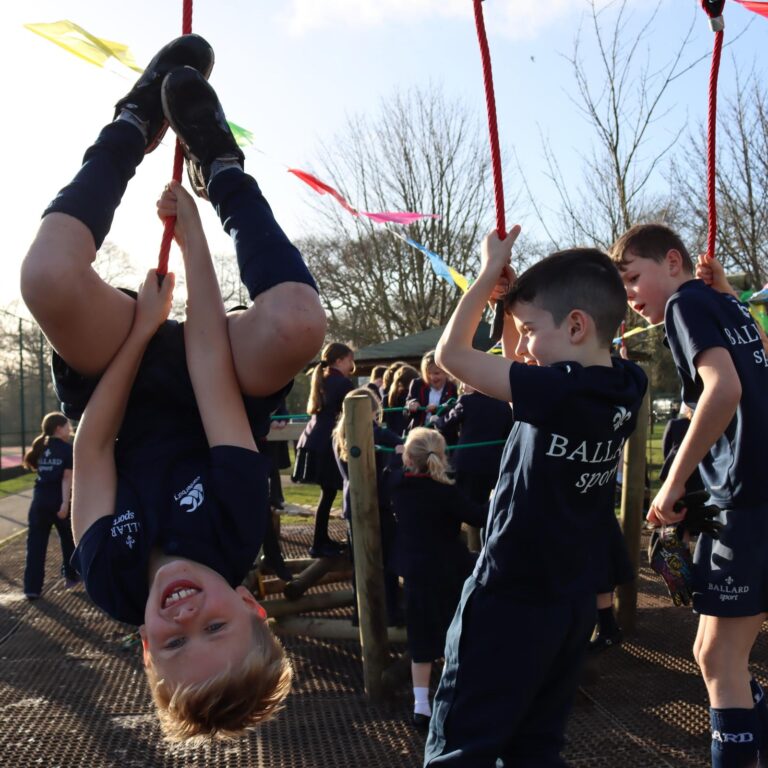
Form tutors take pupils out and about regularly; exploring, investigating, questioning. We visit the nearby beach too. This variety stokes our pupils’ innate love of nature and we integrate this into our day whenever we can. The success of our Forest School lessons underlines the ability of even the youngest child to get involved and let their curiosity lead them.
Ballard’s cross-curricular approach in Pre-Prep enhances our pupils’ learning with recent rain water measurements helping them understand not only our weather (Geography) but volumes and quantities too (Mathematics).
In Geography we also study Human Geography. Year 2 recently made a big map of the New Forest National Park and surrounding area showing all the villages and towns. We then worked out where we all lived and put our pictures there. We also study other cultures; most recently India.
Lower Prep
Our pupils discover their world in Lower Prep Geography with a comprehensive study of the local area, the British Isles and beyond. From learning the basics of grid references to map reading and studying aerial photographs, we develop their curiosity and love of learning.
Form tutors have access to specialist geography resources and equipment, which gives our pupils a head start. For example, our Year 3 pupils have used professional instruments to study the weather.
Our cross-curricular approach allows the pupils to immerse themselves in topics. Year 4’s study of India covers a wide range of topics including; endangered animals, where tea comes from, life in a village in Mumbai, Ghandi and the struggle for freedom. At the end of this topic, we celebrate by immersing ourselves in a special ‘India Day’.
Our hands-on learning encourages creativity and individuality. We recognise that many children learn in different ways so we encourage our pupils to have a go. We give them opportunities to experiment, whether it is creating a ‘live volcano’ or a model earth made from plasticine layers – it gets them thinking.
It was our Lower Prep pupils’ interest in their world which helped create the Eco Committee. Their aim is to educate the whole School in areas such as energy conservation, recycling, studying air quality, growing vegetables and building a grow room. Forest School is also part of the Lower Prep programme.
Upper Prep
Hands-on Geography continues with Year 6 studying weather and climate, including micro-climates and climate change. Rainforests are studied highlighting the causes and consequences of this vital biome’s destruction.
In Year 7 students study settlement, rivers and resource management. As part of our river topic, we undertake data collection in a local river and explore how the river changes from the source to the mouth.
Year 8 pupils explore the processes driving plate tectonics and learn how prediction, preparation and planning can limit the impacts of volcanic eruptions and earthquakes. Development is the final topic studied in Year 8 where the students learn how different indicators can be used to measure levels of development and the reasons behind the development gap.
Senior
Geography is a valued GCSE subject at Ballard and the most popular option subject. Year 9 are prepared for the GCSE course with the study of coastal geomorphology, population and climate change. Again, we use practical observation and activities wherever possible, showing rather than telling.
We study the effects of longshore drift at nearby Milford-on-Sea exploring how effective the coastal management techniques are and the future consequences of climate change.
We study AQA’s Geography syllabus, which consists of Physical and Human Geography and geographical applications (fieldwork, map skills and statistics). Again, we try to make the geography as kinaesthetic as possible; we use ball games to help our pupils remember the processes of erosion and transportation in rivers and the use of stop-frame animation and plasticine to explain how physical features change over time.
Many of our pupils go on to study Geography at A Level and university. Geography has been found to be an employable subject with graduates due to the wide-ranging skills learnt.
We are very proud of our GCSE results in the department with 93% of pupils achieving grades 9-4 and 37% of pupils achieving grades 9-7 (A to A*). (2024 results).