At Ballard, we aim to provide a safe, challenging, positive and creative working environment, which encourages every pupil to work to the best of their ability in Food Technology.
Food Technology at Ballard is taught in such a way that it allows pupils to be informed through a range of learning styles and activities. We want them to become independent learners.
We ensure that pupils gain experience of transferable skills and keep abreast of current food and health issues, which seem to be increasing year on year.
Pre-prep
Our food and cooking curriculum focuses on building foundational life skills, fostering curiosity about food, and promoting healthy eating habits:
- Understand where food comes from (plants, animals, countries).
- Learn about healthy eating using tools like the Eatwell Guide.
- Develop basic cooking skills such as chopping, mixing, and spreading.
- Explore food through sensory experiences (taste, smell, texture).
- Make simple dishes without heat (e.g. fruit salads, sandwiches).
We aim for pupils to:
- Use tools safely: child-safe knives, forks, spoons, scissors.
- Follow simple recipes and instructions.
- Measure ingredients using spoons, cups, and scales.
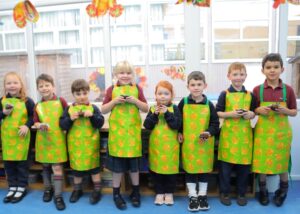
- Practice hygiene: washing hands, cleaning surfaces, wearing aprons.
- Make food choices based on health, taste, and occasion.
- Work collaboratively in small groups or pairs.
Lower Prep
Lower Prep pupils at Ballard benefit from their own dedicated kitchen.
Our aim is for pupils to:
- Understand and apply principles of nutrition and healthy eating
- Prepare and cook a variety of predominantly savoury dishes
- Understand seasonality and food provenance (where and how ingredients are grown, reared, caught, and processed)
- Use measuring tools (spoons, cups, jugs) with increasing accuracy
- Learn about food hygiene and safety
- Explore cultural foods and food choices
- Apply knowledge of nutrition to design healthy meals
Upper Prep
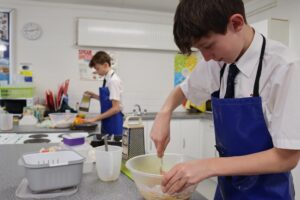
Pupils plan, prepare and cook activities, which cover aspects such as safety, hygiene and working procedures in the classroom. Practical lessons cover the making a variety of high fibre dishes.
In Year 8, pupils have an introduction to sustainability. They use research from various sources to help in the selection of ingredients.
They use sensory evaluation and gain an understanding of social, moral, ethical and sustainable issues. Practical lessons include both sweet and savoury dishes.
Senior
At Ballard, the Senior course ensures that pupils learn the planning, preparation and practical skills required for GCSE.
Other areas include:
- Recognition of target groups and special diets, researching and analysing data.
- Generating and selecting dish solutions and product evaluation
- Product making and planning
- Use of tools and equipment
- Mixing, shaping, preservation, finishing methods, cooking methods
- Properties of food, nutrients and their nutritional value
- Sustainability of ingredients
- Safety and hygiene in the production of a food product
- IT applications to enhance practical work
- Scientific function and physical characteristics of food ingredients and their applications
- Knowledge of health and safety in the food industry.
GCSE IN FOOD PREPARATION & NUTRITION
Years 10 and 11 pupils study the AQA GCSE in Food Preparation & Nutrition. They will be expected to plan, prepare and make a range of high-quality products.
This will take the form of a report, together with practical work with food, leading to a final food exam making three dishes (35%). They will be expected to write a report on the functional, physical and chemical characteristics of a food (15%). They will also sit a written exam worth 50% of the total marks.